
Parole vs Probation in La Plata County
Parole and probation can both begin after a person leaves custody, but they come from different records. Parole follows a CDOC sentence. The Colorado State Board of Parole makes discretionary parole decisions, and CDOC supervises people released to parole. Probation is a court sentence or court-ordered supervision status handled through the Colorado Judicial Branch, including La Plata Probation in Durango.
| Supervision type | Who it applies to | Where to verify it |
|---|---|---|
| Parole | A person released from a Colorado state-prison sentence or returned to parole after a revocation process. | CDOC Offender Search, the parole-board calendar, the Board record, and the Durango Parole Office when local supervision is involved. |
| Probation | A person sentenced by the court to supervision, sometimes after local jail time or instead of a jail or prison sentence. | The La Plata County court docket, sentencing order, probation order, and La Plata Probation office. |
| Pretrial or alternative custody | A person released from the jail building but still under bond conditions, electronic home monitoring, GPS, alcohol monitoring, or other court conditions. | La Plata County Alternatives to Incarceration, the court bond order, and the docket. |
Verify La Plata County Post-Release Supervision
Use the source that matches the sentence. La Plata County's official inmate-search page routes county custody checks to VINELink and state-prison checks to CDOC, so the jail roster alone is not the right proof for supervision after release.
- Start with the case type. If the person was sentenced to CDOC, use CDOC Offender Search. If the person received a local probation sentence, use the court record and probation office.
- Check the court docket or request the sentencing document through the Colorado Judicial Branch record process. The court record can show probation, a mittimus to CDOC, dismissal, warrant recall, bond terms, or other disposition.
- For parole, search CDOC by DOC number when available. CDOC's search tips identify the DOC number as the department's primary identifier.
- For pending parole decisions, check the CDOC parole-board calendar at scheduled parole hearings. The calendar is organized by month and says hearing schedules are subject to change.
- For a local reporting location, use the Durango Parole Office or La Plata Probation contact information below. Those offices can confirm what they are legally allowed to disclose.
- If the person was only in the county jail and does not appear in CDOC, reconcile VINELink status with sheriff records and the court disposition rather than assuming parole.
La Plata Supervising Offices
The local office matters because a statewide database may show status but not explain every reporting instruction. CDOC lists a Durango parole office for the region, while Colorado Judicial Branch lists La Plata Probation at the courthouse complex.
Durango Parole Office
1073 Main Avenue
Durango, CO 81301
970-259-1536
Fax: 970-247-0151
Monday-Friday, 8:00 a.m. to 5:00 p.m.
La Plata Probation
1060 East Second Ave, Suite 107
Durango, CO 81301
970-247-0982
D06_JD_Probation@judicial.state.co.us
Colorado Parole Hearings and Outcomes
The Colorado State Board of Parole says it is a nine-member board created under C.R.S. 17-2-201. Board guidance describes application interviews, rescission hearings, and revocation hearings. In an application interview, a Board member may defer the application or release the inmate to discretionary parole, and some decisions require second-member or full-board review. A rescission hearing can happen after a parole date is granted but before release, while a revocation hearing addresses alleged violations after release.
The scheduled-hearings calendar is published inside CDOC Offender Search. It displays monthly calendars, notes that users can open daily schedules, and warns that hearing schedules are subject to change. The sources reviewed did not identify a separate current public decisions-search portal, so a release decision should be reconciled through the Board record, CDOC offender status, the supervising parole office, and any court or jail record that explains a revocation hold.
Conditions, Violations, and Absconders
Supervision terms are not the same for every person. A probation order may require reporting, treatment, payment, travel restrictions, testing, or electronic monitoring. A parole plan may require reporting to the assigned parole officer, approved residence, treatment, program participation, and compliance with release conditions. The public should avoid treating a jail release as proof that all court or parole conditions ended.
When a person is alleged to have violated parole, Board guidance identifies revocation hearings as the process after release to parole. For probation violations, the court record is the key source because probation is a court sentence. VINELink can help with custody-status changes when a person is booked again, but the exact violation, warrant, or court action should be confirmed through the court, CDOC, the supervising office, or the sheriff records process.
How La Plata Supervision Ends
Probation can end through court termination, successful completion, revocation, resentencing, or another court order. Parole can end through discharge from CDOC jurisdiction, revocation, or completion of the parole term. Colorado's public-records framework treats decisions to grant, order, or terminate probation or parole as part of criminal justice official action, as summarized by the Colorado Attorney General's CORA and CCJRA overview.
For a full release-history check, pair supervision sources with the La Plata County released inmate search path. The sheriff may hold a booking sheet or release notation, the court may hold the sentence and probation order, CDOC may hold the parole or discharge status, and VINELink may document a custody-status alert. No single source covers every county jail, state prison, federal, and immigration path.
La Plata Alternatives to Incarceration
La Plata County's Alternatives to Incarceration page is a local release-adjacent source because it describes Pre-Trial Services, Electronic Home Monitoring, GPS tracking, alcohol monitoring, substance monitoring, and Work Release office services. The county says these offices are at 742 Turner Drive and that regular office services are Monday through Thursday, 8:00 a.m. to 4:30 p.m., with Friday closures since June 2023.
For state supervision, CDOC's parole office list is the source that places the Durango Parole Office in the local release path.
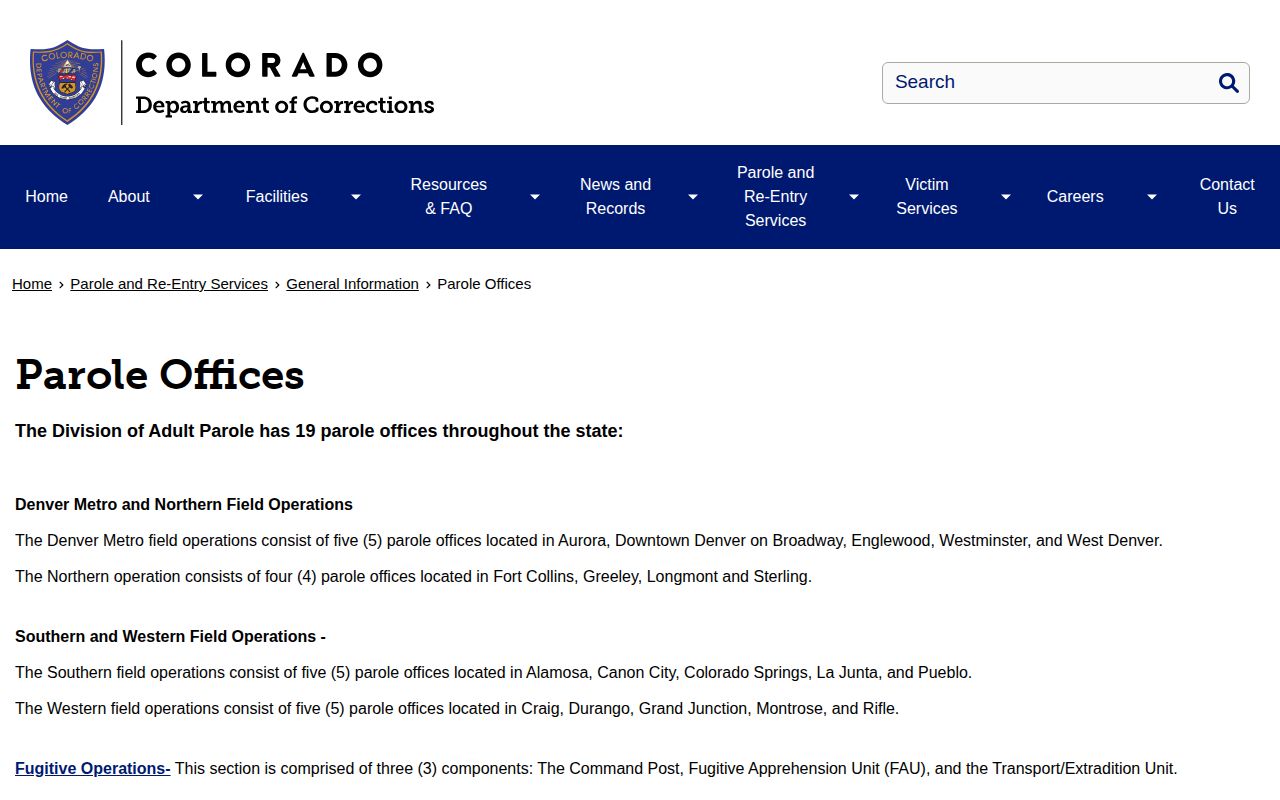
The office list helps separate a CDOC parole release from a county probation sentence handled by the local court office.
This matters for released-inmate checks because a person may be outside the jail building but still under court-ordered supervision. A VINELink no-current-custody result or a disappearance from the active county custody path should be reconciled with the court docket, bond order, ATI status, or probation office when the supervision status matters.
Property and State ID After Release
La Plata County provides a concrete local property-release process. The sheriff's property releases page says an inmate may release property to an outside party by submitting a Property Release request through the detention center's in-house request program, and the named recipient is called when the property is ready.
For people leaving CDOC rather than the county jail, release preparation can include a separate state process. CDOC's State ID Program helps eligible people obtain identification before release. That is not a La Plata County jail property process, but it is relevant when a La Plata felony case became a state-prison sentence and CDOC is the release agency.
Durango Parole and La Plata Probation Detail
The strongest local supervision detail is the side-by-side office split. CDOC's Durango Parole Office at 1073 Main Avenue is the local parole reporting point listed by the state for this region. La Plata Probation, at 1060 East Second Ave, Suite 107, is the local court-probation office listed by the Colorado Judicial Branch. Those are separate agencies, so a person who was released from La Plata County Jail should not be labeled a parolee unless CDOC or the Board record supports it.